01 / Curriculum

Twelve weekly briefs, published before you pay

Each week produces one written brief, one Figma deliverable and one rubric-scored written critique. The briefs, the five-criterion rubric, a verbatim sample critique note and the cohort dates are public on this site, so you can read the whole method before spending anything.
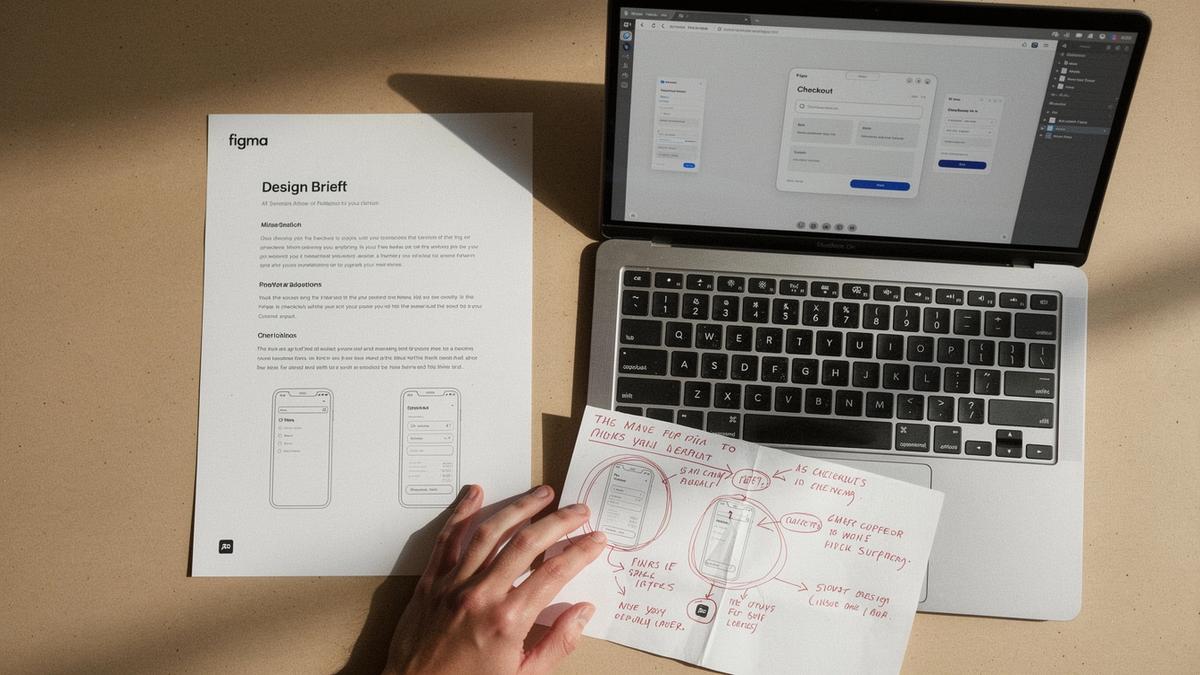
Printed week-four brief on a desk beside a laptop showing a Figma checkout screen and a marked-up critique note
Week 4 brief: rebuild a checkout flow in Figma, then attach the reasoning note and the critique response. Three artefacts, one file.
  • 12Written briefs, one per week, each with a fixed constraint set
  • 3Artefacts per week: interface, reasoning note, critique response
  • 8–10Hours of expected workload per week, including the Figma workshop

Nothing is hidden behind enrolment. Open a brief, read the rubric that will score it, and decide from there.

04 · Assignment ledger

Twelve briefs, published before you pay

Every week produces one written brief, one Figma deliverable and one rubric-scored critique. The constraints below are the ones the cohort works to, unchanged.

  1. 01

    Interface inventory

    One screen of a public-service site; 8pt grid, three type sizes maximum.

    Figma file
  2. 02

    Wireframe from brief

    Grayscale only, no imagery, every block labelled with its job.

    Annotated frames
  3. 03

    Sign-up flow

    Four screens maximum, every state drawn, no dead ends.

    Figma prototype
  4. 04

    Design tokens

    Six colour tokens and four spacing steps, contrast checked at 4.5:1.

    Token sheet
  5. 05

    Dashboard table

    Desktop and 375px frames, tabular numerals, sortable column states.

    Figma file
  6. 06

    Component states

    Default, hover, focus-visible, disabled and error for each control.

    State library
  7. 07

    Mobile navigation

    Tap targets at 44px, keyboard reachable, no hidden traps.

    Figma file
  8. 08

    Accessibility audit

    Find three WCAG AA failures and document each correction.

    Audit note
  9. 09

    Checkout screen

    Single page, plain-language errors, order summary always visible.

    Figma file
  10. 10

    Content-first redesign

    Real copy only; headline and body rewritten, no placeholder text.

    Before and after
  11. 11

    Critique response

    Answer two peer notes in writing, then revise the file.

    Written response
  12. 12

    Portfolio case study

    Three artefacts plus a 600-word reasoning note.

    Case-study page

Each deliverable is scored against the same five criteria. Read the critique protocol.

04 / Critique protocol

Every Figma file comes back with a written critique, scored on five criteria.

No verbal feedback, no voice memos, no “looks good”. Each weekly deliverable is scored 0 to 4 on the rubric below, and the score is written into your own note so you can compare week four with week nine.

  1. 01

    Problem framing 0–4

    Does the screen state who it serves and what decision it supports, in one sentence?

  2. 02

    Hierarchy and layout 0–4

    Can a reader name the first, second and third thing on the screen without being told?

  3. 03

    Type and spacing system 0–4

    Are sizes and gaps drawn from a named scale, or picked ad hoc per frame?

  4. 04

    Component states 0–4

    Default, hover, focus, disabled and error exist as real components, not as copies.

  5. 05

    Reasoning note 0–4

    Does the written note explain the trade-off you rejected, not just the choice you shipped?

Next cohort · twelve weeks

The briefs and the rubric are public. Read them, then decide.

Every week produces one written brief, one Figma deliverable and one rubric-scored written critique. Enrolment for the January cohort closes on 6 January 2026.

  • 12weekly briefs
  • 5rubric criteria
  • 48hfeedback window